DD vs E Cup Bras: Why The Answer Depends On The Sizing System
If you have ever worn a DD cup bra in one brand and then seen an E cup bra listed in another, you are not alone. This question comes up often when shoppers compare brands, especially when one product page lists DD and another uses E.
A DD cup and an E cup are not automatically the same size in every bra. In some US sizing systems, DD and E may be used as very close or alternate labels. In UK sizing, DD and E are usually separate cup steps. In EU and French sizing, E can map differently again.
That sounds like a lot, but the practical takeaway is simple: the letter on the tag only makes sense when you know the sizing system behind it.
Is A DD Cup The Same As An E Cup?

Sometimes, but not in every sizing system.
In many common US bra size labels, DD and E may be used in a similar way. Some brands list the size as DD. Others may use E for a similar cup step. That is why you might see one brand offer 36DD while another shows 36E in a comparable place on the size chart.
In UK bra sizing, DD and E are usually separate cup sizes. A UK E is typically one cup step above a UK DD, so treating them as the same can lead you to choose a cup that is too large or too small.
In EU and French sizing, E often appears in a more straightforward letter progression. Depending on the brand, an EU or French E may be closer to a common US DD than a UK E.
The best starting point is to check the brand’s sizing system before choosing. If you are comparing across brands, our bra size chart can help you see how common size labels often relate, but the brand’s own fit guidance still matters.
Why DD And E Change By Sizing System
Bra sizing would be much easier if every country and every brand used the same letters in the same way. They do not.
The confusion usually starts after a D cup. Many shoppers expect the letters to continue in a simple alphabet pattern, but some sizing systems add double letters while others do not.
That means a cup label can look familiar while meaning something slightly different.
For example, a bra labeled E in one sizing system may not match an E in another sizing system. The same is true for F, FF, G, and many larger cup letters. This is why a shopper can wear one size in a US brand and a different-looking size in a UK brand without her body changing at all.
For a deeper explanation of those differences, our guide to US vs UK bra sizes walks through why the same letter can fit differently.
In Many US Size Labels
In many US sizing systems, the cup progression after D may look something like:
D, DD, DDD
Some US brands use E instead of DD, or F instead of DDD, while others use both labels in different places. That is why US DD and US E can sometimes be treated as close equivalents.
The important word is “sometimes.”
A US brand may use DD and E as alternate labels, but another brand may organize its cup sizes differently. Product pages, tags, and size charts can vary, especially when a retailer carries brands from different countries.
So if you usually wear a DD and you see an E listed, do not assume it is wrong. Also do not assume it is automatically the same. Check the brand’s size chart, look at the cup progression, and compare the band size too.
In UK Bra Sizing
UK sizing is where DD vs E confusion matters most.
UK cup sizing commonly moves from D to DD to E to F to FF. In that system, DD and E are usually not the same cup step. UK E is usually one cup step above UK DD.
You may also see larger cup sizes written with double letters, such as FF or GG. Those are often spoken as double F or double G. Seeing those letters on a size chart is usually a clue that the brand or retailer may be using UK-style cup progression.
This matters because many fuller-bust brands use UK sizing, including brands shoppers may see at specialty boutiques. If you try a UK-sized bra and choose E because you are used to seeing E as a US DD equivalent, the cup may fit differently than expected.
That does not mean UK sizing is better or worse. It simply means the cup letter needs to be read inside the correct system.
In EU And French Bra Sizing
EU and French sizing often use a simpler cup-letter progression, where E may appear as the next common letter after D. The band numbers also look different in many EU or French size labels, which can add another layer of confusion.
For example, a US or UK 34 band does not usually appear as 34 in EU or French sizing. You may see a different band number paired with the cup letter.
Because both the band and cup label can change, it is especially important not to compare the cup letter by itself. A cup conversion is only useful when the full size and sizing system are considered together.
Bra Cup Sizes, Breast Volume, And Cup Progression

Bra cup sizes are not just about the letter. They are also about breast volume, band size, and how the brand organizes its cup progression.
That is why a DD cup size can mean one thing in one system and something slightly different in another. The same is true for an E cup bra size, an F cup, or any larger cup size.
In simple terms, cup volume usually increases as the cup letter moves up within the same band size and the same sizing system. A C cup is usually one cup step above a B cup in that system. A DD is usually larger than a D in that system. But once you start comparing US, UK, EU, and French sizing, the labels do not always line up neatly.
So when you ask whether E is one cup bigger than DD, the answer depends on the cup progression the brand is using. In UK sizing, E is usually one cup step larger than DD. In some US sizing, E may be used closer to DD instead.
That is the piece that matters most: compare the system first, then the cup.
A Simple DD vs E Cup Reference
Use this as a practical starting point, not as a universal rule for every brand.
Label You See |
Often Means |
What To Check |
|---|---|---|
US DD |
Often a common US double-D cup label |
Whether the brand also uses E or DDD |
US E |
May be used similarly to DD in some US brands |
The brand’s cup progression |
UK DD |
Usually the cup step after UK D |
Whether the bra is using UK sizing |
UK E |
Usually one cup step above UK DD |
Whether this maps closer to a US DDD/F starting point |
EU or French E |
Often follows a simpler cup-letter progression |
The full band and cup conversion |
The main lesson is that DD vs E is not just a letter question. It is a sizing-system question.
Why The Band Size Still Matters
A cup letter does not stand alone.
A 32E and a 38E are not the same cup volume, even though the cup letter is the same. Cup volume changes with the band size because bra sizes are built as a band and cup relationship.
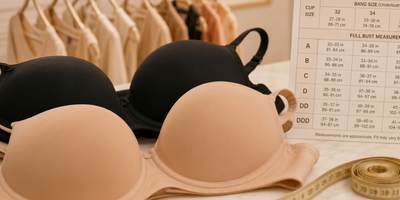
Traditional measuring guides often start with two measurements: a band measurement around the rib cage and a bust measurement around the fullest part of the bust. Some guides may call these a chest measurement, chest circumference, bust size, or bust circumference.
Those two measurements can help you choose a starting point. In many measuring methods, cup volume increases as the inch difference between the band and bust measurement increases. A one inch difference may move the suggested cup size by one step, depending on the method and sizing system. That can make a measuring tape useful, but it does not replace trying the bra on or checking the brand’s sizing system.
The band should do most of the supporting work, which is why cup letters need to be read together with the band size. If the bra band is not doing its job, the cups can shift, gap, spill, or feel less supportive than they really are.
This is one reason sister sizing can be helpful to understand. A sister size keeps a similar cup volume while changing the band size, but it is not a shortcut for ignoring fit. The band still needs to sit firmly and comfortably, and the cup still needs to match your breast shape.
For example, if a 34DD feels too tight in the band, you might wonder whether a 36D could be a nearby sister-size starting point in many systems. That is a band-and-cup adjustment, not the same question as whether DD and E mean the same thing.
If you want to understand that difference more clearly, read our guide to sister sizing in bras.
Why One Bra Fits In DD And Another Fits In E

Even when the size conversion is close, two bras in similar sizes can fit very differently.
That is because the size on the tag does not tell you everything about the bra’s shape or construction.
A DD or E cup may feel different depending on:
Cup depth
Wire width
Cup height
Stretch or firm fabric
Molded cups versus seamed cups
Full coverage versus plunge or balconette shapes
Strap placement
Brand fit personality
A molded T-shirt bra, for example, may gap at the top if the cup shape is too tall or too shallow for your breast shape. A seamed bra in the same size may fit more closely because the cup has more shaping built into it. A plunge bra may feel lower at the center, while a full coverage bra may give more containment.
A well-fitting cup should comfortably contain breast tissue without cutting in, spilling, or leaving obvious empty space.
That is why a size conversion is only the starting point. Fit still depends on how the bra is built and how it works with your body.
If you are trying to figure out whether the issue is the size or the style, our guide to how a bra should fit can help you check the band, cups, straps, wires, and center gore in a practical way.
How To Check Which Size System A Brand Uses
When you are shopping online or comparing brands, look for clues before choosing between DD and E.
Start with the size chart. A good brand or retailer chart will often show whether the bra uses US, UK, EU, or French sizing. If the chart shows cup letters like FF, GG, or HH, that is usually a sign you are looking at UK-style cup progression. If the chart uses DDD, that often points toward US-style sizing.
You can also look at the brand’s origin or fit notes, but the size chart is usually more useful than guessing from the brand name alone.
Here are a few practical checks:
Look at the full cup progression, not just one size.
Check whether DD and E both appear in the same chart.
Look for UK-style double letters such as FF or GG.
Check whether the band number is US/UK style or EU/French style.
Read product-page notes when a retailer carries international brands.
Compare the size chart before assuming your usual cup letter transfers.
If you like comparing brands by fit personality, the Shop by Brand page can be a useful next step after you understand the sizing system.
What To Do If You Are Between DD And E

If you are not sure whether to try DD or E, start by identifying the sizing system first.
A helpful decision path looks like this:
Check the brand size chart.
Look at the cup progression after D.
Confirm whether the bra uses US, UK, EU, or French sizing.
Compare the full size, including the band.
Think about the fit issue you are trying to solve.
Use the cup letter as a starting point, not the final answer.
If your current DD cup cuts in at the neckline, feels too shallow, or leaves breast tissue spilling at the top or sides, you may need more cup room. If your current E cup gaps, wrinkles, or feels too tall in the cup, you may need a different cup size, a different cup shape, or a different style.
The fit sign matters as much as the label, so pay attention to how the bra fits on your body.
Also check the band before changing only the cup. If the band is too loose, the cups may shift and create gapping or spillage that looks like a cup problem. If the band is too tight, the cups may feel more strained than they really are.
Common Fit Signs To Compare
When you are deciding between nearby sizes, pay attention to what the bra is doing on your body.
Measurements can help you choose a starting point, but cup letters still need to be read within the brand’s sizing system. That is why the fit signs on your body matter more than the letter alone.
The cup may be too small or too shallow if:
Breast tissue spills over the top or sides
The wire sits on breast tissue
The center gore floats away from the body in an underwire bra
The cup edge cuts in
You feel compressed in a way that does not feel supportive
The cup may be too large, too tall, or the wrong shape if:
The cup wrinkles or collapses
There is empty space at the top of the cup
The wire feels too wide for your shape
The straps sit too far apart
The bra feels like it is covering more than you want without giving better support
The band may be part of the issue if:
It rides up in the back
It shifts during the day
You need to overtighten the straps for lift
It feels uncomfortably tight even when the cups seem right
The cups fit differently after you adjust the band
These signs do not diagnose your correct bra size perfectly, but they can help you decide what to check next. Sometimes what looks like the wrong bra size is really the wrong style, wrong shape, or an ill-fitting bra in a brand that does not suit your proportions.
Why The Tag Is Only A Starting Point

It is tempting to think the right conversion will solve everything. In real fitting rooms, it is usually more personal than that.
Two women can wear the same printed size and need completely different bra styles because body shape can make the same size look and feel very different. One may need deeper cups. One may need narrower wires. One may prefer a firmer band. One may do better in a stretch lace top cup because it adapts more easily to her shape.
That is why The Bra Diva team treats sizing as a starting point. The number and letter help narrow the options, but the best fit comes from looking at the whole bra.
A size chart can get you close. A brand chart can help you compare systems. A fitting can help you understand what your body, breast volume, and preferred styles are actually asking for.
When A Fitting Can Help
A fitting can be especially helpful when you keep switching between DD and E but neither one feels quite right.
That may mean the issue is not only the cup letter. It could be the band, cup shape, wire width, style, or brand. It could also be that one brand’s DD and another brand’s E are not built the same way.
A professional fitter can help you compare sizes across brands, check whether the band is doing enough of the support work, and notice when the issue is shape or style rather than just the cup letter.
The goal is not to chase a perfect bra from the label alone. It is to find a secure fit that feels comfortable for everyday wear, gives enough support for your needs, and fits properly through both the band and cups.
If you are tired of guessing, you can book a fitting appointment with The Bra Diva and get help narrowing the options.
FAQs About DD vs E Cup Sizes
Is DD the same as E cup?
DD and E can be similar in some US sizing systems, but they are not the same in every brand or country. In UK sizing, E is usually one cup step above DD. The safest starting point is to check the brand’s size chart and confirm which sizing system it uses.
Is an E Cup Bigger Than a DD Cup?
In UK bra sizing, an E cup is usually one cup step above a DD cup, so a UK E is typically not the same as a UK DD. In some US sizing systems, E may be used closer to DD instead. If you are switching between US and UK brands, compare the full size chart before choosing.
What does an E cup bra size mean?
An E cup bra size depends on the sizing system. In some US systems, E may be used near DD. In UK sizing, E is usually one cup step above DD. In EU or French sizing, E often follows a simpler cup-letter progression. Always check the full size chart before choosing.
Is US DD the same as UK DD?
US DD and UK DD are often close, but the fit can still vary by brand, style, and cup shape. Some US systems may also use labels such as DDD or F after DD, which can add to the confusion. Use the conversion as a starting point, then check how the bra actually fits.
Why does an E cup fit differently in different brands?
An E cup can fit differently because brands may use different sizing systems, cup shapes, wire widths, fabrics, and construction methods. A molded E cup may feel very different from a seamed E cup, even when the tag looks similar.
Should I try DD or E if I am not sure?
First check whether the bra uses US, UK, EU, or French sizing. Then look at your fit signs. If the cup cuts in or spills, you may need more cup room. If the cup gaps or wrinkles, you may need a different size, shape, or style. If you are still unsure, a fitting can help you compare both options more confidently.
The Bottom Line On DD vs E Cup Bras

DD and E cup sizes are confusing because the answer changes by sizing system.
In many US labels, DD and E may be used closely. In UK sizing, E is usually a different cup step from DD. In EU and French sizing, E may map differently again. The band size, brand, style, and cup shape all matter too.
So instead of asking only, “Am I a DD or an E?” ask, “Which sizing system is this brand using, and how does this bra actually fit my body?”
That question will get you much closer to a bra that feels supportive, comfortable, and right for real life.