US vs UK Bra Sizes: Why the Same Letter Can Fit Differently
If you have ever worn one bra size in one brand and a different size in another, you are not alone. Bra sizing can feel especially confusing when you start comparing US and UK bra sizes, because the same cup letter does not always mean the same cup volume.
This is one of those fitting-room questions we hear often: “I thought I was a G cup, so why does this UK brand say something different?”
The short answer is that US and UK band numbers are usually similar, but cup letters can change, especially after DD. That means your printed size is a helpful starting point, but it is not the whole fit story. The brand’s sizing system, the cup shape, the wire shape, and the style of the bra all matter too.
Why US And UK Bra Sizes Can Be Confusing

Bra sizes look simple from the outside: a number for the band and a letter for the cup. A 34G sounds like it should be a 34G everywhere.
In real life, it is not always that straightforward.
The number usually refers to the band size, while the letter refers to the cup volume in relation to that band. But different countries and brands do not always use the same cup-letter progression. That is where US vs UK bra sizes start to trip shoppers up.
This becomes especially noticeable in fuller cup sizes. A shopper may wear a US 34G in one brand, then try a UK-sized brand and find that the closest starting point is often closer to a UK 34F. That does not mean her body changed. It simply means the sizing system changed.
A good way to think about it is this: the size label is a language. US sizing and UK sizing may use some of the same letters, but after a certain point, they do not always speak the same language.
The Band Number Is Usually The Easier Part
For most US and UK bra sizes, the band number is the easier part to understand. A US 34 band and a UK 34 band are usually intended to be similar starting points.
That does not mean every 34 band will feel identical. Some brands run firmer, some stretch more, and some styles feel different because of fabric, construction, or the number of hooks. But the band-number system itself is generally more aligned between US and UK sizing than the cup-letter system.
So if you are comparing a US 34G and a UK 34F, the band number may stay the same while the cup letter changes.
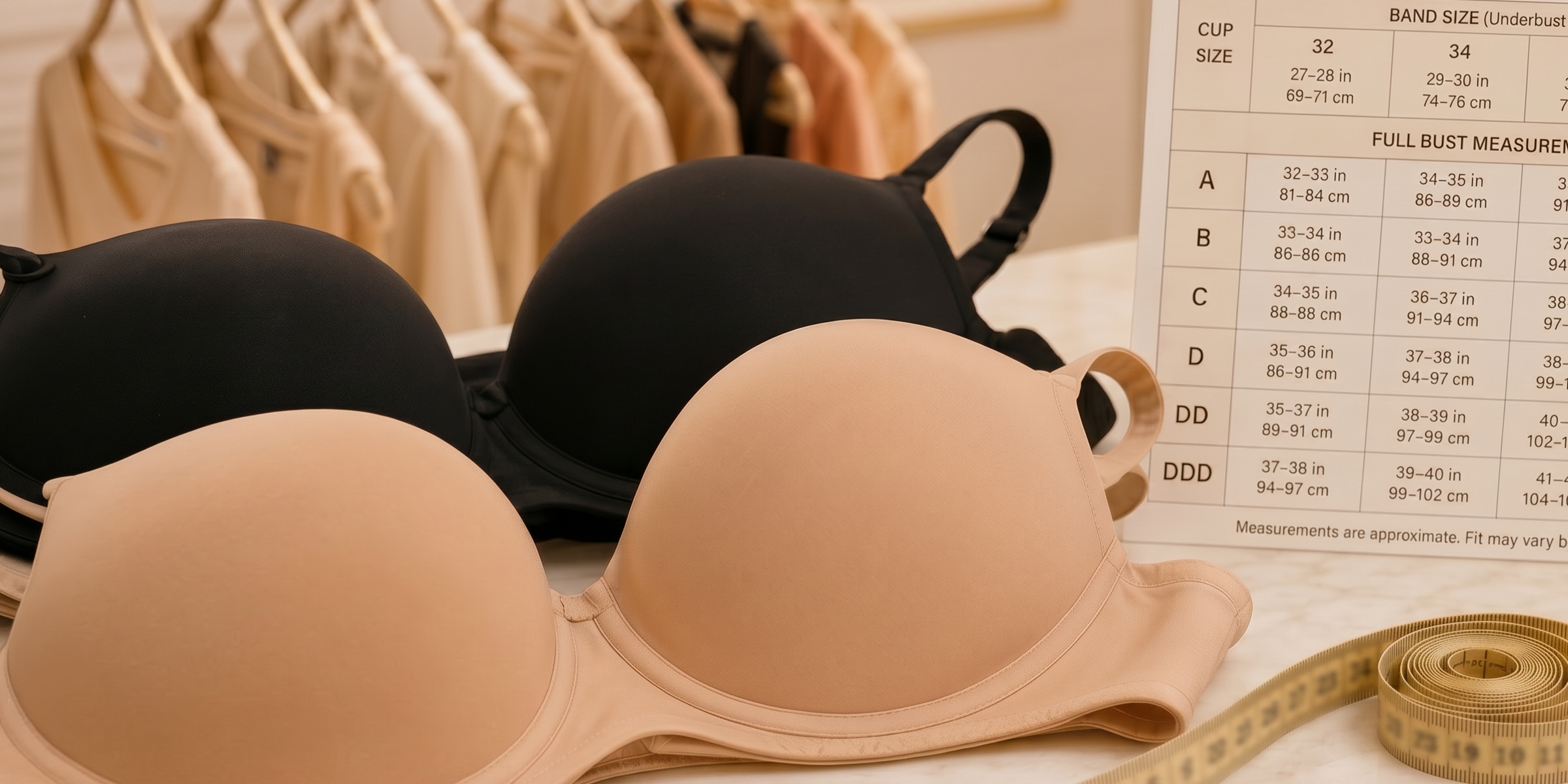
If you are not sure where your band size should begin, The Bra Diva’s bra size chart can help you check your starting point before you compare brands. When measuring, focus on a snug underbust measurement for the band and a full-bust measurement for the cup, then use the chart as a starting guide rather than a final verdict.
Cup Letters Are Where US And UK Sizing Start To Differ
Cup letters are where the confusion usually begins.
In smaller cup sizes, US and UK sizing often look fairly similar. A, B, C, and D are usually more straightforward across both systems, though not everyone fits neatly into one standard. Once you move beyond D and DD, the systems often begin to separate.
Many US brands use letters such as DD, DDD, G, H, I, J, and so on. Many UK brands use both single and double cup sizes in a progression such as DD, E, F, FF, G, GG, H, HH, J, JJ, and so on. Another common difference is that UK sizing typically does not use the letter I, while many US size progressions do.
That is why a US G is not always the same as a UK G.
Where The Systems Usually Look Similar
At the beginning of the cup alphabet, US and UK sizes are usually easier to compare:
-
US A is usually close to UK A.
-
US B is usually close to UK B.
-
US C is usually close to UK C.
-
US D is usually close to UK D.
-
US DD is often close to UK DD.
This is why some shoppers do not notice a major difference until they move into fuller cup sizes.
What Happens After DD
After DD, the cup progression often changes.
In many US systems, the next cup after DD may be labeled DDD or F. In many UK systems, the next cup after DD is usually E. Then UK sizing continues through F, FF, G, GG, H, HH, and so on.
This is the part that makes shoppers feel like they are moving backward or forward in the alphabet when they are really just switching systems.
For example, a US DDD or US F is often closest to a UK E, depending on the brand. A US G is often closest to a UK F. A US H is often closest to a UK FF.
Those conversions are useful, but they are not universal rules. They are starting points.
A Practical US To UK Bra Size Reference
Here is a simple way to think about common US and UK cup-size comparisons. Use this as a starting guide, not a final answer for every brand.
|
Common US Cup |
Often Closest UK Cup |
Fit Note |
|---|---|---|
|
A |
A |
Usually similar across US and UK systems. |
|
B |
B |
Usually similar across US and UK systems. |
|
C |
C |
Usually similar across US and UK systems. |
|
D |
D |
Usually similar across US and UK systems. |
|
DD |
DD |
Often close, but still check the brand. |
|
DDD or F |
E |
A common point of confusion. |
|
G |
F |
UK F is often near US G. |
|
H |
FF |
UK FF is often near US H. |
|
I |
G |
UK G is often near US I. |
|
J |
GG |
UK GG is often near US J. |
|
K |
H |
UK H is often near US K. |
|
L |
HH |
UK HH is often near US L. |
|
M |
J |
UK J is often near US M. |
|
N |
JJ |
UK JJ is often near US N. |
The most important phrase here is “often closest.” Bra sizing can vary by brand, style, and construction, so do not treat a conversion chart as a guarantee.
If you are shopping a brand you have never worn before, always check the brand’s sizing system and size chart before choosing.
Why The Same Converted Size Still May Not Fit

Even when you convert the size correctly, the bra may not fit exactly the way you expect.
That can be frustrating, but it is normal. Size conversion only compares the label. It does not account for the shape of the bra or the shape of your body.
A converted size may still feel different because of:
-
Cup depth: Some cups are deeper and more projected, while others are shallower.
-
Cup width: Some wires are wider, while others are narrower.
-
Cup height: Some styles come up higher on the breast, while others are more open at the neckline.
-
Fabric: Stretch lace, molded foam, mesh, and laminated fabrics all behave differently.
-
Style: A plunge bra, balconette bra, T-shirt bra, sports bra, and full coverage bra can all fit differently in the same printed size.
-
Brand fit personality: Some brands are known for firmer bands, deeper cups, or more structured construction.
This is why two bras in your “correct” converted size may not feel the same. One may contain beautifully, while another may gap at the top, spill at the center, or feel too wide under the arm.
That does not mean the conversion is useless. It simply means it is only the first step.
How To Check Which Sizing System A Brand Uses
Before ordering, try to confirm whether the brand uses US, UK, EU, or French sizing. This is especially important if you wear DD+ cup sizes.
Here are a few practical clues.
First, look at the brand’s size chart. If you see cup letters such as FF, GG, HH, or JJ, you are probably looking at UK-style cup progression.
Second, look at the brand itself. Many fuller-bust brands use UK sizing, especially brands known for D+ or fuller-cup construction. Some European brands may use EU or French sizing, which can look different again. That does not mean every style in a brand will fit the same, but it gives you a useful starting point.
Third, check the product page and retailer notes. A good bra retailer should help clarify the sizing system when it matters.
Fourth, pay attention to the tag. Some bras show multiple size systems on the label. Just make sure you are reading the one that matches the retailer or brand’s sizing guidance.
If you are comparing brands, The Bra Diva’s Shop by Brand page can help you browse different fit personalities and sizing patterns.
Common Examples That Trip Shoppers Up
Sometimes examples make this easier than a chart.
Example 1: US 34DDD vs UK 34E
If you usually wear a US 34DDD, a UK 34E may often be the closer starting point in many UK-sized brands.
That can feel strange because E may look “smaller” or “different” if you are used to US labels. But in UK cup progression, E comes after DD.
The important question is not whether the letter feels familiar. The important question is whether the band stays level, the cups contain the breast tissue, and the bra feels supportive without digging or gaping.
Example 2: US 34G vs UK 34F
A US 34G is often closest to a UK 34F. This is one of the most common places where shoppers get confused because both systems use the letter G, but not at the same point in the cup progression.
If you order a UK 34G when you really needed a UK 34F, you may end up in a cup that is too large. That can create gapping, wrinkling, or a cup that feels too tall or too roomy.
Example 3: US 32H vs UK 32FF
A US 32H often maps near a UK 32FF. Again, the double-letter system can look unfamiliar at first, but it is normal in UK sizing.
If you see FF on a tag, it does not mean the brand is doing something unusual. It usually means the brand is using a UK-style cup progression.
Example 4: Same Size, Different Shape
You may also try two UK 34F bras and find that one fits beautifully while another does not. That is not necessarily a sizing-system issue. It may be a shape issue.
One bra may have deeper cups. Another may be shallower. One may have a taller cup edge. Another may have a more open neckline. This is why a fitter looks at both size and style, not just the label.
What To Do If Your Converted Size Does Not Fit

If your converted size does not fit, do not assume you did something wrong. Start with a simple fit check.
Check The Band First
The band should sit level around your body and feel firm enough to anchor the bra. If the band rides up, feels loose, or shifts when you move, the cup size may not be the only issue.
A loose band can make the cups behave strangely. It can cause gapping, slipping straps, or a lack of lift, even when the cup volume is close.
Look At The Cup Next
The cups should contain your breast tissue without cutting in, spilling, flattening, or leaving large empty spaces.
If the cup cuts in at the top or center, you may need more cup volume or a different cup shape. If the whole cup feels empty, you may need less cup volume. If only the top edge gaps, the issue may be cup shape rather than size.
Notice The Center Gore
In many underwire bras, the center gore should sit close to the body between the breasts. If it floats away, the cups may be too small, too shallow, or not the right shape for your breast tissue.
There are exceptions depending on body shape and style, but a floating gore is a useful clue.
Compare The Style, Not Just The Size
A T-shirt bra may fit very differently from a lace full-cup bra in the same size. Molded cups can be less forgiving if your breast shape does not match the cup shape. Stretch lace may adapt more easily to natural asymmetry or upper-cup fullness.
If your converted size seems close but not quite right, the next step may be trying a different style rather than jumping several cup sizes.
Use Sister Sizing Carefully
Sister sizing can help in some situations, but it is not a fix for every problem. Moving from a 34F to a 36E, for example, changes both the band and cup relationship. That may help if the band is too firm, but it may not help if the real issue is cup shape.
Because sister sizing deserves its own explanation, the main thing to remember here is this: change the band only if the band fit is part of the problem.
US vs UK Sizing Matters Most In Fuller Cup Sizes

Many shoppers in A through D cups may not notice a major US vs UK conversion issue. The sizing can still vary by brand, but the cup letters are usually easier to compare.
The difference becomes more important as you move into DD+ cup sizes. That is where UK double-letter sizing and US cup progression can create more confusion.
This is also where good fit guidance matters more. Fuller cup sizes often need more precise cup depth, wire placement, band support, and strap positioning. A small mismatch in cup volume or shape can make a bra feel very wrong, even if the label looks close.
If you are browsing fuller-cup options, The Bra Diva’s women’s bras collection can help you compare styles, brands, and sizes with fit in mind.
A Bra Size Chart Helps, But It Cannot Do Everything
A bra size chart is a useful tool. It can help you understand where to start, especially when you are comparing US, UK, EU, and French sizing.
But a chart cannot tell you everything a fitting can.
It cannot see whether your breast tissue is fuller on top, fuller on bottom, close-set, wide-set, projected, shallow, or asymmetrical. It cannot tell whether a specific wire shape will feel comfortable. It cannot tell whether a molded cup will gap at the top or flatten your shape.
That is why we like to treat size charts as maps, not verdicts. They point you in the right direction, but you still need to check how the bra behaves on your body.
If you are unsure, a professional fitting can save a lot of guessing. You can book a fitting appointment with The Bra Diva for more personalized help.
Final Takeaway: The Letter Is Not The Whole Fit Story
US vs UK bra sizes can feel confusing because the same cup letter does not always mean the same cup volume. The band number is usually the easier part, while the cup letters start to differ more after DD.
A conversion chart can help you choose a better starting size, especially if you are shopping UK-sized brands. But your best fit still depends on the brand, the style, the cup shape, the wire shape, and how the bra actually sits on your body.
So if your usual size changes from one brand to another, do not take it personally. Your body did not become harder to fit. You are just moving between sizing systems, and once you know how to read them, shopping gets much easier.
Frequently Asked Questions About US And UK Bra Sizes

Are US and UK bra band sizes the same?
US and UK band sizes are usually similar. A US 34 band and a UK 34 band are generally intended to be close starting points. The fit may still vary by brand, fabric, and style, but the bigger sizing difference is usually in the cup letters.
Is a US DDD the same as a UK E?
A US DDD, sometimes labeled US F, is often closest to a UK E. This is not a universal rule for every brand, but it is a helpful starting point when comparing US and UK cup progression.
Why do UK bra sizes have double letters like FF and GG?
UK sizing often uses double letters as part of its cup progression after DD. That is why you may see sizes such as FF, GG, HH, and JJ in UK-sized brands. These letters are normal in UK bra sizing and do not mean the bra is unusual.
Should I order my usual US size in a UK brand?
Usually, no. If the brand uses UK sizing, you should convert your US cup size to the closest UK starting point and then check the brand’s size chart. This matters most in DD+ cup sizes, where the cup-letter systems often differ. If the first converted size is not quite right, use the brand’s size chart and your fit checks to adjust from there.
Is a bra size conversion chart enough to find my size?
A conversion chart is a good starting point, but it is not enough on its own. Fit also depends on the brand, style, cup shape, wire width, fabric, and your own breast shape. Use the chart to narrow your options, then check how the bra fits on your body. The chart works best when your measurements are accurate and the goal is the right fit, not just the closest label.
Why does the same bra size fit differently across brands?
The same size can fit differently because brands use different patterns, fabrics, cup depths, wire shapes, and sizing systems. A 34F in one brand may feel deeper, wider, firmer, or more open at the neckline than a 34F in another brand. That is why fit clues matter as much as the printed size.